THE ‘RIDDLE’ ARTWORK IN DETAIL
£5,000
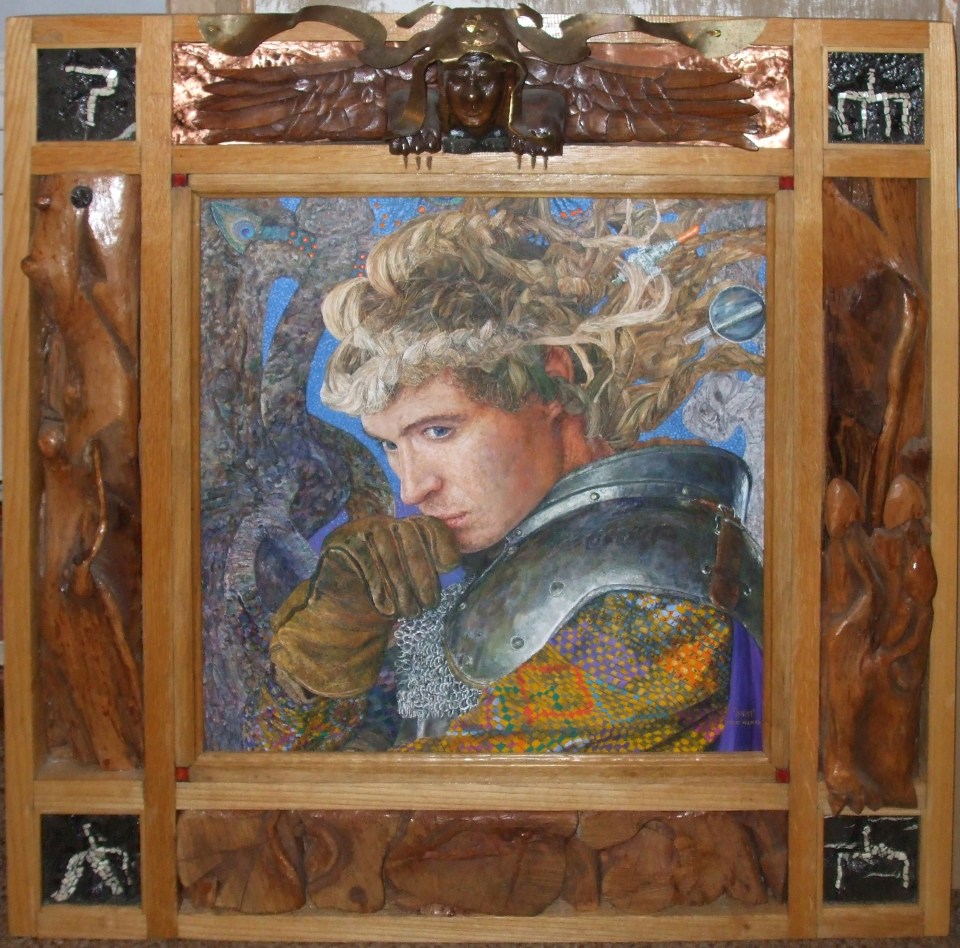
An acrylic on canvas painting, within an Oak, Mahogany, lignum and Apple wood frame. There are additions of granet, brass and copper.
This artwork is heavy, weighing 22.4kg
This work is based on the story of Oedipus. Having been told that he was destined to kill his father and marry his mother, Oedipus left his home country and travelled to Thebes. In the dessert his way was barred by the Sphinx, a mysterious creature, part woman part animal. The Sphinx, who had a taste for human flesh set him a riddle. If Oedipus solved the riddle he would be free to pass, if not, he would suffer the fate of the unfortunates whose bones lay around.
The riddle posed was ‘What walks on four legs, then two legs, then three legs’. Oedipus after pondering the puzzle answered ‘Man’. As a child he crawls on all fours, as a man he walks upright on two legs and as an old man, with the aid of a stick walks he on three legs.
Starting at top left and moving clockwise, the corners relate to the riddle. First a question mark, then a stylised four legs, then two legs then three legs. These corners are black granite blocks with marble stones set in. The Sphinx sits atop the frame, its tail coming to a point within the painting. The apple wood insets around the frame are carved from pieces of one tree. The forms of the tree parts dictates the direction that the carving took, coupled with sexualised shapes making reference to the dark nature of his fate. Woven into the hair of Oedipus are a hearing trumpet and a child’s teething ring, these elements are a reference to the riddle. There are textual features on the sleeve and glove relating to parts of the story of Oedipus.
 Philip Palmer Fine Art